After Klal Yisrael defeated the formidable duo of Sichon and Og and conquered their lands in the Transjordan, it would have seemed natural for them to plant their flag there and call it a day.
But in this week’s Parsha, Parshas Ki Savo, Hashem commanded them to continue forward, to cross the Jordan and enter the land of Israel. As for the Transjordanian territories, Hashem said that they would be divided among the tribes of Reuven, Gad, and half of Menashe.
The verse says: _“When you reached this place, King Sihon of Heshbon and King Og of Bashan came out to engage us in battle, but we defeated them. We took their land and gave it to the Reubenites, the Gadites, and the half-tribe of Manasseh as their heritage.”_ (Devarim 29, 6-7)
But in this week’s Parsha, Parshas Ki Savo, Hashem commanded them to continue forward, to cross the Jordan and enter the land of Israel. As for the Transjordanian territories, Hashem said that they would be divided among the tribes of Reuven, Gad, and half of Menashe.
The verse says: _“When you reached this place, King Sihon of Heshbon and King Og of Bashan came out to engage us in battle, but we defeated them. We took their land and gave it to the Reubenites, the Gadites, and the half-tribe of Manasseh as their heritage.”_ (Devarim 29, 6-7)
(ו) וַתָּבֹ֖אוּ אֶל־הַמָּק֣וֹם הַזֶּ֑ה וַיֵּצֵ֣א סִיחֹ֣ן מֶֽלֶךְ־חֶ֠שְׁבּ֠וֹן וְע֨וֹג מֶלֶךְ־הַבָּשָׁ֧ן לִקְרָאתֵ֛נוּ לַמִּלְחָמָ֖ה וַנַּכֵּֽם׃ (ז) וַנִּקַּח֙ אֶת־אַרְצָ֔ם וַנִּתְּנָ֣הּ לְנַחֲלָ֔ה לָראוּבֵנִ֖י וְלַגָּדִ֑י וְלַחֲצִ֖י שֵׁ֥בֶט הַֽמְנַשִּֽׁי׃
(6) When you reached this place, King Sihon of Heshbon and King Og of Bashan came out to engage us in battle, but we defeated them. (7) We took their land and gave it to the Reubenites, the Gadites, and the half-tribe of Manasseh as their heritage.
On the surface, this episode is a demonstration of Klal Yisrael’s faith in Hashem; there they were, standing on newly conquered ground, but to stay true to Hashem’s directive for them to enter Eretz Yisrael, they continued forward to the promised land, and left it behind.
In other words, they were being told to neglect the adage “a bird in the hand is worth two in the bush.”
But the Malbim, in his inimitable style, extracts an additional lesson. Hashem’s command that Klal Yisrael forgo continue onto Eretz Yisrael was an implicit attestation to the praiseworthiness and superior value of Eretz Yisrael. Hashem knew that Klal Yisrael settling on the Transjordan would have been settling for way less than they would have in Israel.
Imagine watching a football game with your team down just a few points towards the end of the game. They start driving down the field, electrifying both the stadium (and your living room). In the final few seconds the quarterback tosses a perfect over the shoulder pass to a sprinting wide receiver who brings it to the one-yard line!
Out of timeouts, the clock continues to tick, but instead of trying to get off another play, the team jumps for joy and begin to celebrate on the one-yard line.
The camera pans to the sideline, where the coach is frantically yelling and signaling to his team to run the next play! But they’re oblivious, caught up in their celebration. Meanwhile, the clock ticks down to triple zeros, and the opposing team can’t believe their eyes.
This scenario, though improbable (except maybe if it was the Browns) encapsulates the internal struggle Klal Yisrael had at the Transjordan. They had just won a hard fought battle and gained new territory, but their goal wasn’t to settle there, it was to get to the promised land, so Hashem prodded them forward.
In our own lives, we all have our “Transjordanian” moments. We work hard, achieve a certain level of success, but then then rest on our laurels and bask in our previous accomplishments. A major reason people tend to “stop short” of their goals is because they don’t have them clearly defined, similar to how Klal Yisrael may have been okay stopping in Transjordan.
This way, you can see for yourself whether you’re on the "one yard one", or if you can rightfully spike the ball in the endzone.
In other words, they were being told to neglect the adage “a bird in the hand is worth two in the bush.”
But the Malbim, in his inimitable style, extracts an additional lesson. Hashem’s command that Klal Yisrael forgo continue onto Eretz Yisrael was an implicit attestation to the praiseworthiness and superior value of Eretz Yisrael. Hashem knew that Klal Yisrael settling on the Transjordan would have been settling for way less than they would have in Israel.
Imagine watching a football game with your team down just a few points towards the end of the game. They start driving down the field, electrifying both the stadium (and your living room). In the final few seconds the quarterback tosses a perfect over the shoulder pass to a sprinting wide receiver who brings it to the one-yard line!
Out of timeouts, the clock continues to tick, but instead of trying to get off another play, the team jumps for joy and begin to celebrate on the one-yard line.
The camera pans to the sideline, where the coach is frantically yelling and signaling to his team to run the next play! But they’re oblivious, caught up in their celebration. Meanwhile, the clock ticks down to triple zeros, and the opposing team can’t believe their eyes.
This scenario, though improbable (except maybe if it was the Browns) encapsulates the internal struggle Klal Yisrael had at the Transjordan. They had just won a hard fought battle and gained new territory, but their goal wasn’t to settle there, it was to get to the promised land, so Hashem prodded them forward.
In our own lives, we all have our “Transjordanian” moments. We work hard, achieve a certain level of success, but then then rest on our laurels and bask in our previous accomplishments. A major reason people tend to “stop short” of their goals is because they don’t have them clearly defined, similar to how Klal Yisrael may have been okay stopping in Transjordan.
This way, you can see for yourself whether you’re on the "one yard one", or if you can rightfully spike the ball in the endzone.
(א) ונקח את ארצם. עתה יאמר להם איך שנתן לנו ה' מתנה טובה את הארץ אשר תבואו בה ואם אף שלא באתם לשם אבל הלא ברור אצלנו כי עלה נעלה וירשנו אותה. שהרי ונקח את ארצם ונתנה לנחלה לראובני ולגדי ולחצי שבט המנשי. אחרי שהארץ אשר לקחנו משני המלכים ע"י המלחמה היא בעינינו חביבה למאד - עכ"ז נתן לשני שבטים ומחצה, בכדי שלא יטלו חלק בארץ, נוכל להבין שאנחנו בטוחים בירושת הארץ וכי יקרה היא מאד וחביבה!, כדרך הארץ שמי אשר נותן עתה דבר שבידו בכדי שיקבל אחרי כן לעמתו דבר אחר, בטח הדבר ההוא יקר הרבה מהדבר אשר נותן עתה:
As an interesting endnote, I read an intersting thing in the Essential Malbim. (Artscroll)
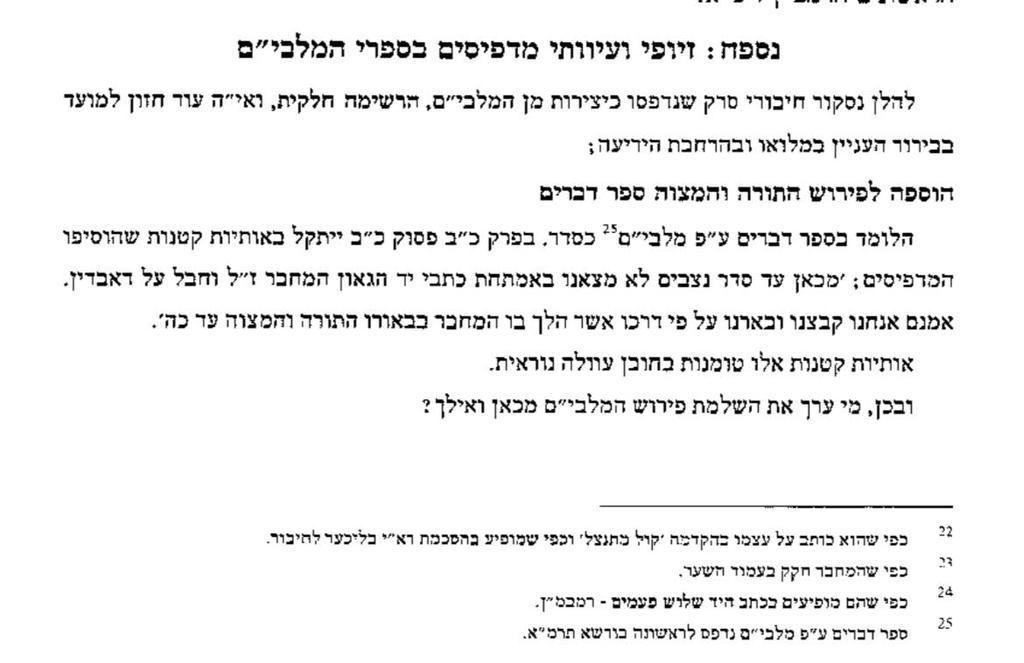
The pirush ascribed to the Malbim between Ki Teizei and Nitzavim is not actually the Malbim, since the Malbim didn't write on this section of the Torah. In a later printing of the Malbim, an "announcement" in small letters introduced this section that read:
"From here until Nitzavim, the Malbim didn't write, but I have written in his style" Malbim's style - but it is not actually from the Malbim."
Although it was clear it wasn't the Malbim, the identity of the author of this work was largely unknown.
Here's the story behind it, (as told to Rav Avraham Yeshaya Zacharish by Rabbi Yitzchak Yeshaya Weiss in a 1974 Yeshurun article, in which R' Weiss testified to have read this self-authored account by the ghostwriter himself.)
The Malbim's first volume was printed in Bucharest in 1860. A young child named Yosef began to learn Chumash, unbeknowst to him, in the style of the Malbim. He began to write his thoughts down, but not in a formal sefer format, just a little here and a little there.
One day, young Yosef went into a seforim store and began to leaf through the Malbim's sefer and he was elated - he had been learning along the same lines as one of the great minds of his generation! Unfortunately, he could not afford the sefer, so his relationship to the actual contents of the Malbim was minimal, and he forgot about the Malbim's sefer.
A year later, something prompted Rav Yosef to start to write down his commentary more thoroughly and more organized. At that time, he was also able to afford a copy of the Malbim's sefer, which he then bought, and this time he saw that he had really been pretty much on the mark in imitating his style - without even making a consious effort.
On September 18, 1879, the Malbim passed away. The publisher for the Malbim's seforim was planning on going into a second printing of the Malbim's seforim, and somwhow got in touch with Rav Yosef. After looking at his work, and the fact that Rav Yosef wrote on parts that the Malbim had not, the publisher offered to include Rav Yosef's work to fill in the parts the Malbim missed.
And so, in the second release of the Malnim in 1881 (5641) in Warsaw, the Malbim featured this enigmatic statement introducing the work of Rav Yosef HaLevi Yaavetz.
There is a whole Wikipedia page about it (including the Yeshurun article, which I included below) about this mysterious author.
The pirush ascribed to the Malbim between Ki Teizei and Nitzavim is not actually the Malbim, since the Malbim didn't write on this section of the Torah. In a later printing of the Malbim, an "announcement" in small letters introduced this section that read:
"From here until Nitzavim, the Malbim didn't write, but I have written in his style" Malbim's style - but it is not actually from the Malbim."
Although it was clear it wasn't the Malbim, the identity of the author of this work was largely unknown.
Here's the story behind it, (as told to Rav Avraham Yeshaya Zacharish by Rabbi Yitzchak Yeshaya Weiss in a 1974 Yeshurun article, in which R' Weiss testified to have read this self-authored account by the ghostwriter himself.)
The Malbim's first volume was printed in Bucharest in 1860. A young child named Yosef began to learn Chumash, unbeknowst to him, in the style of the Malbim. He began to write his thoughts down, but not in a formal sefer format, just a little here and a little there.
One day, young Yosef went into a seforim store and began to leaf through the Malbim's sefer and he was elated - he had been learning along the same lines as one of the great minds of his generation! Unfortunately, he could not afford the sefer, so his relationship to the actual contents of the Malbim was minimal, and he forgot about the Malbim's sefer.
A year later, something prompted Rav Yosef to start to write down his commentary more thoroughly and more organized. At that time, he was also able to afford a copy of the Malbim's sefer, which he then bought, and this time he saw that he had really been pretty much on the mark in imitating his style - without even making a consious effort.
On September 18, 1879, the Malbim passed away. The publisher for the Malbim's seforim was planning on going into a second printing of the Malbim's seforim, and somwhow got in touch with Rav Yosef. After looking at his work, and the fact that Rav Yosef wrote on parts that the Malbim had not, the publisher offered to include Rav Yosef's work to fill in the parts the Malbim missed.
And so, in the second release of the Malnim in 1881 (5641) in Warsaw, the Malbim featured this enigmatic statement introducing the work of Rav Yosef HaLevi Yaavetz.
There is a whole Wikipedia page about it (including the Yeshurun article, which I included below) about this mysterious author.