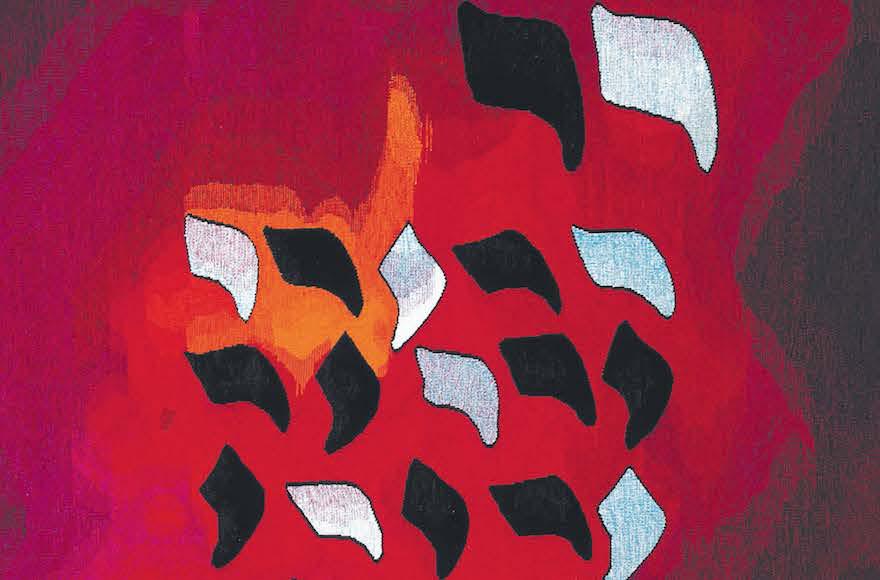
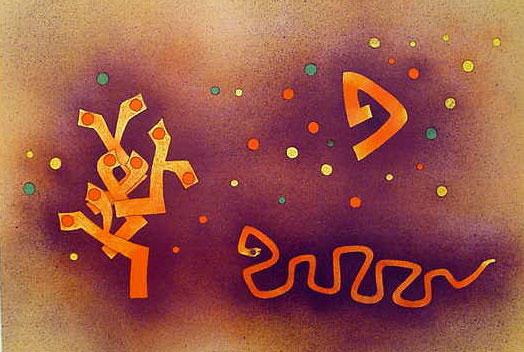
Detail of Ayin Samekh Nun from The Creation, ca. 1978-1980, a series of ten tapestries designed by Mordecai Ardon (1896-1922).
The tapestries, executed at the Georges Goldstein Atelier, Jerusalem, were donated by Ardon to Shaare Zedek Medical Center, Jerusalem, where they are permanently exhibited. © Mordecai Ardon / Courtesy Ardon Estate
Link:
Mordecai Ardon, one of Israel’s best-known painters, dies at age 95 in Jerusalem. June 18, 1992
Born Max Bronstein in Galicia in 1896, he ran away from his religiously observant family at 13 and wandered Europe before studying acting in Berlin after World War I. When he switched to art and applied to the Bauhaus school, he immediately attracted Paul Klee as a mentor and studied with Johannes Itten, Wassily Kandinsky and Lyonel Feininger. In 1926 he moved to Munich and studied with Max Doerner for three years. He returned to Berlin for a time, then fled to Prague to escape trouble over his involvement in communism.
He moved to Jerusalem in 1933 and changed his name to Mordecai Ardon in 1936. He was drawn to the earth of Palestine but struggled to adapt to the harsh light. His work evolved to feature symbolism, including Kabbalah, and to depict the connections between the visible and the invisible. Rather than work in pure abstraction, Ardon began with realistic pieces and abstracted them as he worked. Some of Ardon’s most famous works featured symbolic representations of Nazi soldiers and imprisoned Jews during the Holocaust.
Considered the father of the regional approach to art in Israel, he was committed to teaching. He was an instructor at the Bezalel School of Arts and Crafts (now the Bezalel Academy of Arts and Design) from 1935 to 1952 and served as the school’s director from 1940 to 1952. He was a supervisor and art adviser for the Education and Culture Ministry from 1952 to 1963.
Ardon was awarded the UNESCO Prize in 1954 and the Israel Prize in 1963, but it wasn’t until he retired from teaching at age 65 that he devoted himself to painting full time while splitting time between Paris and Jerusalem. One of his most famous works, created for the Hebrew Library, is a stained-glass window, “Isaiah’s Vision for Eternal Peace.”
See Wikipedia:
"Most of Ardon’s paintings from the 1930s and from his later period are landscapes that transform Jerusalem’s hills and valleys into vibrant tones and stirring rhythms. Ardon became more spiritual and more interested in Jewish history and tradition after his move to Jerusalem, and his work became increasingly abstract and poetic. Numerous canvases reflect his attachment to ancient Middle-Eastern culture and his love for Kabbalistic literature, out of which he created a vocabulary of pictorial symbols. Working on a monumental scale, Ardon painted several triptychs depicting subjects such as war, the Holocaust, and the earthly and divine Jerusalem. From 1982 to 1984 he worked on a stained-glass window entitled Isaiah’s Vision of Eternal Peace for the National Jewish University and Library in Jerusalem."
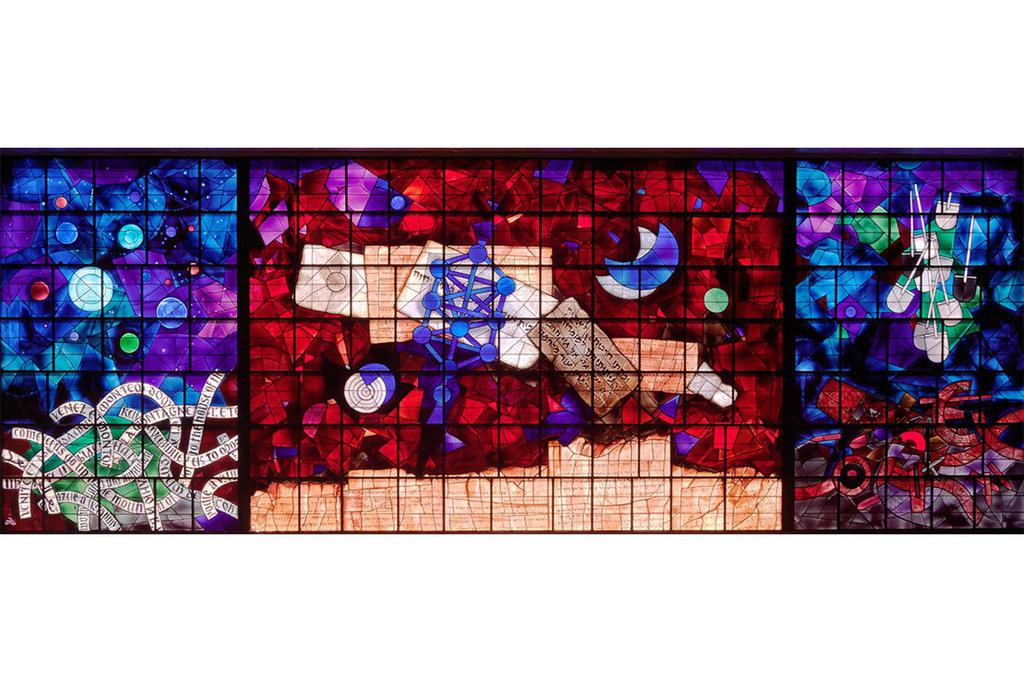
(Isaiah II:2-4)
"The left panel depicts the roads taken by the nations on their way to Jerusalem. Each road is marked by the verse, "Come let us go up to the mountain of the Lord…" in several different languages and alphabets including Latin, Greek, and Arabic.
The middle panel focuses on Jerusalem. At the bottom of the panel, the city wall is represented as the Dead Sea Scroll of the Book of Isaiah. Above the wall a piece of parchment carries part of the prophecy, "and they shall beat their swords into ploughshares". Next to the parchment one can see a network of blue circles and lines – the Kabbalistic Tree of Sefirot. To the left of the Tree is a composition of Sefirot made of concentric circles, also derived from the Book of the Zohar.
The right panel is Isaiah's vision come true: guns and shells beaten into spades that hover above them."
/-/-/-/-/-/-
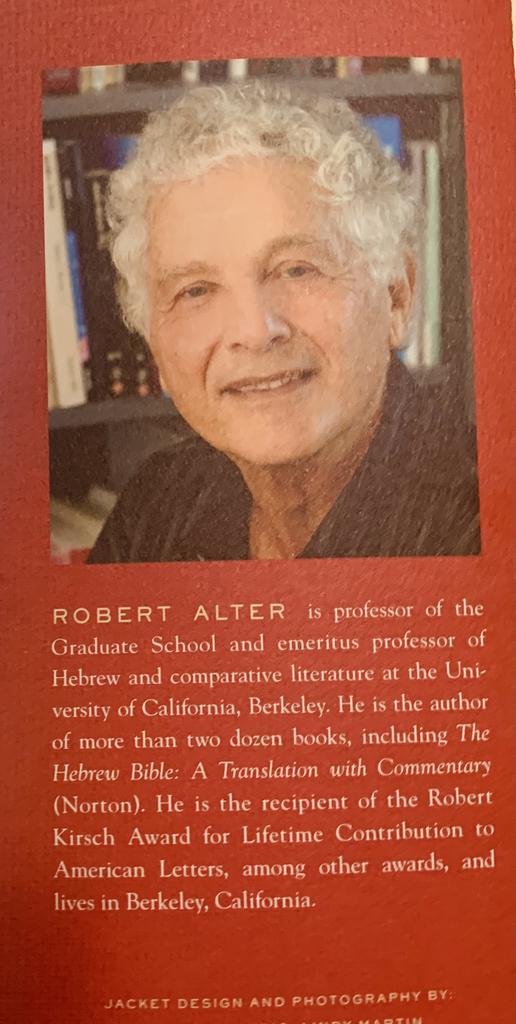
Alter, Robert. The Hebrew Bible: A Translation with Commentary: Three-Volume Set W. W. Norton & Company. Kindle Edition.