


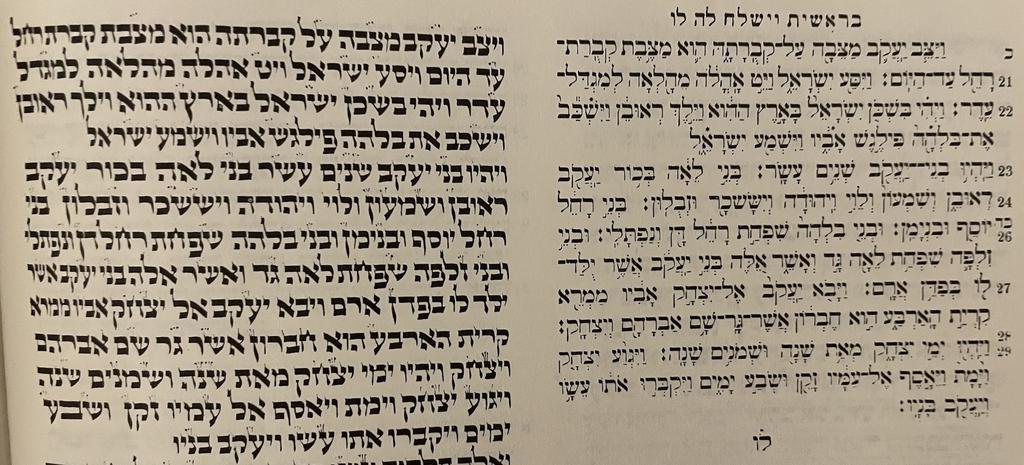
וַיִּֽהְי֥וּ בְנֵֽי־יַעֲקֹ֖ב שְׁנֵ֥ים עָשָֽׂר׃ (כג) בְּנֵ֣י לֵאָ֔ה בְּכ֥וֹר יַעֲקֹ֖ב רְאוּבֵ֑ן וְשִׁמְעוֹן֙ וְלֵוִ֣י וִֽיהוּדָ֔ה וְיִשָּׂשכָ֖ר וּזְבֻלֽוּן׃
(19) Thus Rachel died. She was buried on the road to Ephrath—now Bethlehem. (20) Over her grave Jacob set up a pillar; it is the pillar at Rachel’s grave to this day. (21) Israel journeyed on, and pitched his tent beyond Migdal-eder. (22) While Israel stayed in that land, Reuben went and lay with Bilhah, his father’s concubine; and Israel found out.
Now the sons of Jacob were twelve in number. (23) The sons of Leah: Reuben—Jacob’s first-born—Simeon, Levi, Judah, Issachar, and Zebulun.
Rabbi Shmuel bar Nachmani said that Rabbi Yonatan said: Anyone who says that Reuben sinned is nothing other than mistaken, as it is stated: “...Now the sons of Jacob were twelve” (Genesis 35:22). This teaches that all them were equal. How then do I establish the meaning of the verse: “And he lay with Bilhah his father’s concubine”? This verse teaches that Reuben rearranged his father’s bed. And the verse ascribes to him liability for his action as if he had actually lain with her.
It was taught that Rabbi Shimon ben Elazar says: This righteous person, Reuben, was saved from that sin of adultery, and that action did not come to be performed by him... How then do I establish the meaning of the verse: “And he lay with Bilhah his father’s concubine”? It is understood as follows: He protested the affront to his mother. He said: If my mother’s sister Rachel was a rival to my mother, will my mother’s sister’s concubine be a rival to my mother? He immediately stood and rearranged her bed so that Jacob would enter Leah’s tent.
My might and first fruit of my vigor,
Exceeding in rank
And exceeding in honor. (4) Unstable as water, you shall excel no longer;
For when you mounted your father’s bed,
You brought disgrace—my couch he mounted!
(1) The sons of Reuben the first-born of Israel. (He was the first-born; but when he defiled his father’s bed, his birthright was given to the sons of Joseph son of Israel, so he is not reckoned as first-born in the genealogy).
33] And Jacob went and dwelt to the south of Magdaladra'ef. And he went to his father Isaac, he and Leah his wife, on the new moon of the tenth month. And Reuben saw Bilhah, Rachel's maid, the concubine of his father, bathing in water in a secret place, and he loved her. And he hid himself at night, and he entered the house of Bilhah [at night], and he found her sleeping alone on a bed in her house. And he lay with her, and she awoke and saw, and behold Reuben was lying with her in the bed, and she uncovered the border of her covering and seized him, and cried out, and discovered that it was Reuben. And she was ashamed because of him, and released her hand from him, and he fled. And she lamented because of this thing exceedingly, and did not tell it to any one. And when Jacob returned and sought her, she said unto him: 'I am not clean for thee, for I have been defiled as regards thee; for Reuben has defiled me, and has lain with me in the night, and I was asleep, and did not discover until he uncovered my skirt and slept with me.' And Jacob was exceedingly wroth with Reuben because he had lain with Bilhah, because he had uncovered his father's skirt. And Jacob did not approach her again because Reuben had defiled her.
Give ear to Reuben your father in the commands which I give unto you. And behold I call to witness against you this day the God of heaven, that ye walk not in the sins of youth and fornication, wherein I was poured out, and defiled the bed of my father Jacob. And I tell you that he smote me with a sore plague in my loins for seven months; and had not my father Jacob prayed for me to the Lord, the Lord would have destroyed me. …after this I repented with set purpose of my soul for seven years before the Lord. And wine and strong drink I drank not, and flesh entered not into my mouth, and I ate no pleasant food; but I mourned over my sin, for it was great, such as had not been in Israel.
Pay no heed to the face of a woman, nor associate with another man’s wife, nor meddle with affairs of womankind. For had I not seen Bilhah bathing in a covered place, I had not fallen into this great iniquity. For my mind taking in the thought of the woman’s nakedness, suffered me not to sleep until I had wrought the abominable thing. For while Jacob our father had gone to Isaac his father, when we were in Eder, near to Ephrath in Bethlehem, Bilhah became drunk and was asleep uncovered in her chamber. Having therefore gone in and beheld nakedness, I wrought the impiety without her perceiving it, and leaving her sleeping I departed. And forthwith an angel of God revealed to my father concerning my impiety, and he came and mourned over me, and touched her no more…
For until my father’s death I had not boldness to look in his face, or to speak to any of my brethren, because of the reproach. Even until now my conscience causeth me anguish on account of my impiety. And yet my father comforted me much and prayed for me unto the Lord, that the anger of the Lord might pass from me, even as the Lord showed. And thenceforth until now I have been on my guard and sinned not.
(י) מַעֲשֵׂה רְאוּבֵן (בראשית לה), נִקְרָא וְלֹא מִתַּרְגֵּם. מַעֲשֵׂה תָמָר (בראשית לח), נִקְרָא וּמִתַּרְגֵּם. מַעֲשֵׂה עֵגֶל הָרִאשׁוֹן (שמות לב), נִקְרָא וּמִתַּרְגֵּם. וְהַשֵּׁנִי (שם), נִקְרָא וְלֹא מִתַּרְגֵּם. בִּרְכַּת כֹּהֲנִים (במדבר ו), מַעֲשֵׂה דָּוִד (שמואל ב י״א:כ״ז) וְאַמְנוֹן (שמואל ב יג), לֹא נִקְרָאִין וְלֹא מִתַּרְגְּמִין. אֵין מַפְטִירִין בַּמֶּרְכָּבָה (יחזקאל א), וְרַבִּי יְהוּדָה מַתִּיר. רַבִּי אֱלִיעֶזֶר אוֹמֵר, אֵין מַפְטִירִין בְּהוֹדַע אֶת יְרוּשָׁלַיִם (יחזקאל ט״ז:ב׳):
(10) The incident of Reuben, is read from the Torah in public but not translated. The incident of Tamar (Genesis, chapter 38) is read in public and also translated. The first report of the incident of the Golden Calf (Exodus 32:1–20), is read and translated, but the second (Exodus 32:21–24) is read but not translated. The verses constituting the Priestly Benediction (Numbers 6:24–26) and the incident of David and Amnon (II Samuel, chapter 13) are neither read nor translated...
So, did Reuben commit a grave sin, or was he spared from doing so at the last minute? Did Jacob, or God, punish him and if so, in a limited way, or for eternity? Did Moses mitigate the punishment or reiterate it? How should we retell this story to our children, if we can’t determine “what really happened”?
Some might read the Talmud as suggesting that pious Jews ought to tell a single simplistic story of Reuben’s (non-)deed, and to consider this story to be what “really” happened in the Bible—even though it is far from the biblical account itself. It is clear from the Talmudic discussion, however, that the various Sages who are quoted were not simply repeating a prescribed formula, but were responding to the problems of the biblical text.
To me, this seems to be a primary purpose of biblical narratives—to transmit a common lore of tradition to serve as a basis for discussions about what really matters[12]. What “really happened” is less important for a religious reader than the lessons to be learned, and the conversations about these lessons. In such “trigger” texts, gaps are an important part of the story, generating valuable theological and moral discussion. The literal gap in the Reuben and Bilhah story–the pisqa be’emsa passuq– serves to remind us that our role as readers and transmitters is to fully engage the text and its possibilities, to pay attention to what is there, and what is not, and to consider together how we might fill in what is missing.
I accept the fullness of who my father was, flaws and all. I am angry with him. And I refuse to see his faults as the totality of who he was.